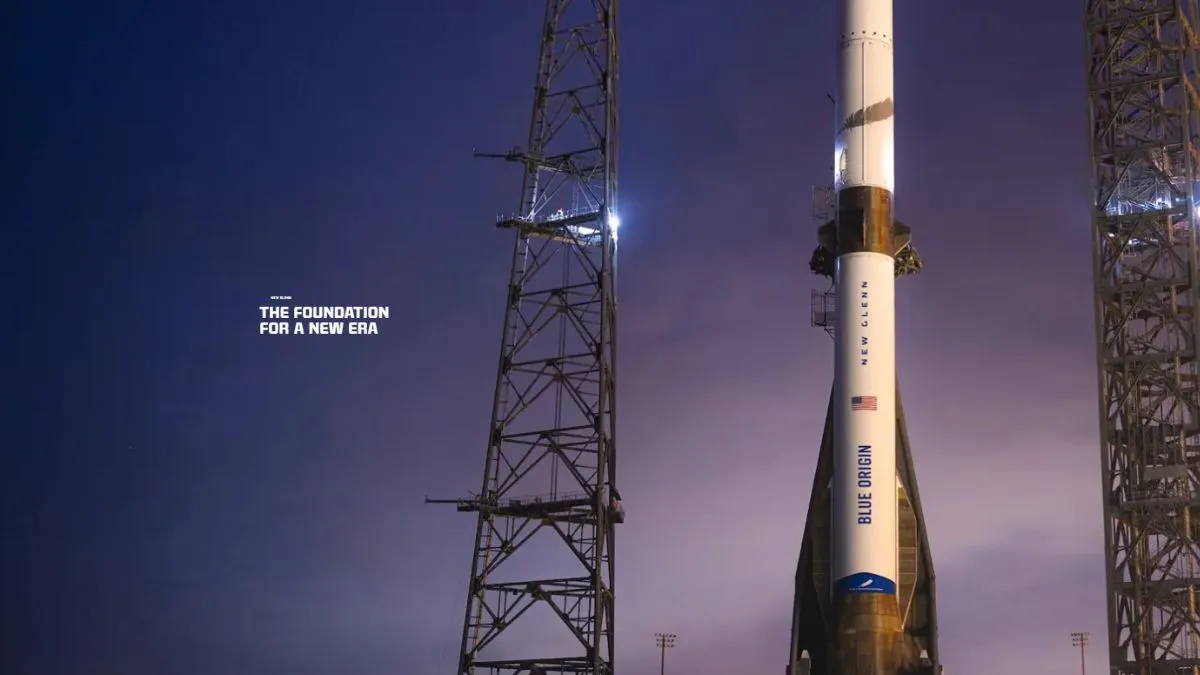
Blue Origin, the private space company founded by Jeff Bezos (the founder of Amazon), is gearing up for the next launch of its New Glenn rocket, which will carry NASA’s ESCAPADE mission to Mars. Earlier this month, the company successfully transported the first stage of its second New Glenn (NG-2) rocket to the launch pad at Cape Canaveral, Florida. The mission is expected to launch in late October or early November 2025, marking a major milestone for Blue Origin’s heavy-lift rocket program.
New Glenn Rocket: Design and power
Standing tall at 98 meters (320 feet), New Glenn is one of the tallest rockets in the world. It is designed to rival SpaceX’s Falcon Heavy and other next-generation launch systems. The rocket’s first stage is powered by seven BE-4 engines that use liquid methane and oxygen, while the second stage features two BE-3U engines fueled by liquid hydrogen and oxygen.
Blue Origin plans to reuse the first-stage booster of New Glenn, similar to SpaceX’s approach to reusability. Although the rocket’s first flight in January 2025 successfully reached orbit, it failed to land the booster safely. The upcoming NG-2 mission will be a crucial test of Blue Origin’s ability to recover and reuse the rocket stage, an essential step for cost-effective space operations.


NASA’s ESCAPADE Mission to Mars
The ESCAPADE (Escape and Plasma Acceleration and Dynamics Explorers) mission is one of NASA’s key upcoming Mars research projects. It consists of two identical small satellites, nicknamed Blue and Gold, built by Rocket Lab. Both satellites arrived at Florida’s Space Coast in September for final preparations.
These probes will study how solar wind and space weather interact with Mars’ upper atmosphere, helping scientists understand how Mars gradually lost its atmosphere over billions of years. This mission will also test Blue Origin’s ability to conduct deep-space launches, a first for the New Glenn rocket.