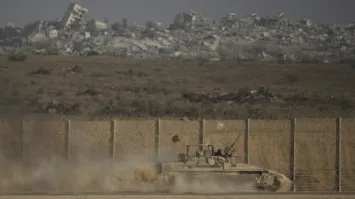
Israel expanded its ground invasion of Gaza City on Tuesday, with two divisions advancing and a third expected to join the operation. This escalation follows weeks of intense airstrikes that have reduced entire apartment blocks to rubble. Gaza City, home to hundreds of thousands of Palestinian residents, remains under siege as Israel intensifies its efforts to dismantle Hamas’ military infrastructure. Amid the ground offensive and rising casualties, residents in the city were urgently warned to evacuate and head south for their safety.
Heavy strikes and rising casualties
Images from the Israel-Gaza border on Tuesday showed thick plumes of smoke rising above Gaza City, marking the escalation of military activity. The city has endured intense bombardments, and early reports indicate at least 20 Palestinians have been killed, with 90 more wounded after a strike hit several homes in a western neighbourhood.
Shifa Hospital in Gaza reported receiving the bodies of the deceased, with doctors describing a night of continuous bombings that left many bodies still buried under the rubble. The ongoing violence exacerbates the already dire humanitarian crisis, with famine conditions reported in the city due to Israeli aid restrictions.


Hostage families urge ceasefire
The military operation has prompted a wave of protests from the families of Israeli hostages still held in Gaza. Families gathered outside Prime Minister Benjamin Netanyahu’s residence, calling for an immediate halt to the offensive to ensure the safe return of their loved ones. Some hostages, including children, have been used as human shields, which has intensified calls for a ceasefire. While Israel believes many hostages are still alive, Hamas has demanded the release of Palestinian prisoners in exchange for their freedom.
Global reactions and Egypt’s escalating criticism
International reaction continues to grow, with Egypt, a long-time mediator in the Israel-Palestine conflict, becoming increasingly critical of Israel’s actions. Egyptian President Abdel-Fattah el-Sissi referred to Israel as “an enemy” for the first time since the two countries signed a peace treaty in 1979. This rhetoric marks a significant shift in Egypt’s stance and signals growing frustration over Israel’s military campaign in Gaza.
As the violence intensifies, global diplomatic efforts continue, but a ceasefire remains elusive as the humanitarian crisis deepens.
(AP inputs)